Rent Repayment Orders · England
Can I Get Rent Back?
Under English housing law you can make a Rent Repayment Order (RRO) application to get up to 2 years’ rent back for a range of landlord offences. You apply to the tribunal yourself — no solicitor needed. Or you can get representation from us and we will manage the whole process for you.
Everything depends on one date
The rules changed on 1 May 2026. Before you read anything else, work out when your landlord’s offence was committed — it decides how much you can claim, how long you have to claim it, and who you can claim it from.
It ended before 1 May 2026
Old rules: up to twelve months’ rent, and twelve months to apply. That window may be closing.
What the old rules are →It started on or after 1 May 2026
New rules: up to twenty-four months’ rent, two years to apply, and the property owner can be made to pay.
What changed →It ran across the date, or is still going
Your claim splits in two at midnight on 30 April 2026. One application, both sets of rules.
How the split works →Two questions, in this order
People usually arrive asking one big question, but it’s really two, and they have different answers in different places. Neither takes long.
1. Did my landlord commit an offence?
Ten offences qualify, and four out of five claims are about licensing. You don’t need to know the law — one email to the council usually settles it, and it’s free to ask.
What decides each one →2. Can I make an application?
Whether you are the sort of applicant the tribunal can help: the right country, the right kind of home and landlord, and still in time. Five questions, answered below.
Run the checker →If the answer to both is yes, you have a claim worth making. If you’re unsure about either, send us an enquiry — advice is free either way.
Can I make a Rent Repayment Order application?
Five questions, answered in your browser — nothing is stored and nothing is sent. This tells you whether you can apply: the right country, the right kind of home, the right kind of landlord, and still in time. It does not tell you whether your landlord committed an offence — that’s the other question, and it’s usually settled by one email to the council.
Start with the guide — it’s free
Everything below is on this site somewhere, but the guide is where it’s all in one place and in order. It’s the same document we work from ourselves.
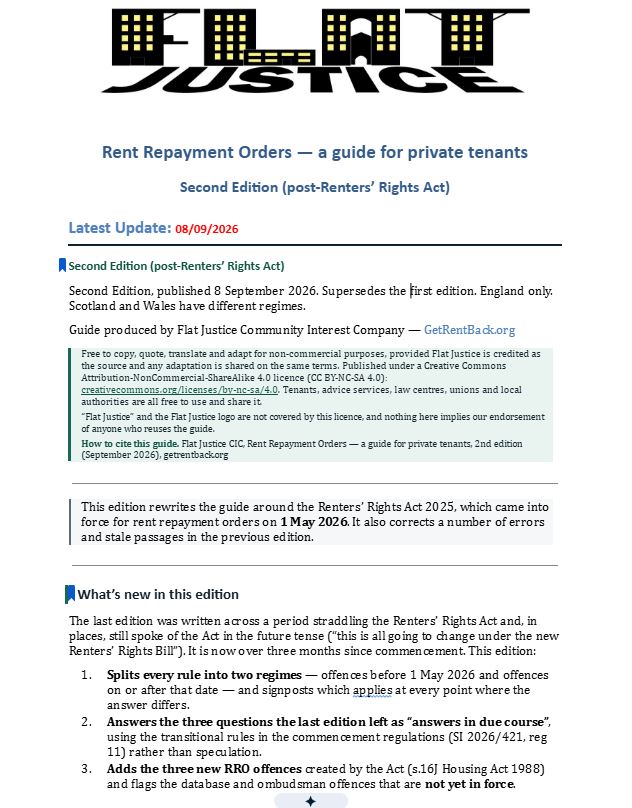
Rent Repayment Orders — a guide for private tenants
Second edition, September 2026 · rewritten for the Renters’ Rights Act
The offences, the timing rules, choosing who to claim against, the evidence, the RRO1, the bundle, the hearing, quantum, costs and enforcement. Written for tenants running their own applications, and used by advisers, law centres and unions.
Free to copy, quote and adapt for non-commercial use under a Creative Commons licence. England only.
Three ways we can help — two of them free
Do it yourself
Our tenant guide covers the whole process: the offences, the evidence, the form, the bundle, the hearing, enforcement. Second edition, rewritten for the new Act.
Free advice while you do it
Stuck on the occupancy table, the fee remission form or a case management hearing? Email or ring us. We don’t charge for this.
We run it for you
We pay the tribunal fees, prepare the submissions and advocate at the hearing, for 20% of what is actually recovered — payable only once the money arrives.
New this year: the Renters’ Rights Act
The Act made the biggest change to Rent Repayment Orders since they were created, and most guidance online hasn’t caught up. Ours has.
What changed on 1 May 2026
Twice the rent. Twice the time. The property owner and company directors can now be made to pay. Three new offences, and a repeat-offender rule worth more than any of it.
Read the overview →Straddling offences
When the offence ran across the changeover date, the claim splits in two. Worked examples, and the deadline trap that comes with it.
See the split →The ten offences
What now counts as an offence, including the three tenancy-reform offences the Act created, and what decides each one.
See the list →Thinking about it? Read this first
An RRO application is a legal claim against your landlord and it takes months, not weeks. Before you start it’s worth knowing what you’re taking on — how long it runs, what evidence you will have to dig out, what a realistic award looks like, and the reasons we sometimes tell people not to bother.
Don’t sit tight in an unlicensed property waiting for a better moment. An unlicensed house has usually never been inspected, and unlicensed properties are where the serious hazards are found. An RRO application almost always forces the landlord to apply for a licence, which brings the council in and gets the property checked.
If you’re worried about your immediate safety, contact your council’s private sector housing team now, without waiting for anything on this site.