The basics
How Rent Repayment Orders work
A Rent Repayment Order is an order from a tribunal telling your landlord to pay rent back to you, because they committed one of ten housing offences. You apply directly. Your council doesn’t need to prosecute your landlord first.
Councils were prosecuting very few landlords for these offences, so Parliament gave the power to tenants instead. Since April 2017 private tenants have been able to apply on their own. In practice an application usually forces the landlord to apply for a licence, which brings the council in and gets the property inspected.
One thing surprises almost everyone: an award is not compensation for what you went through. It is a penalty on the landlord that happens to be paid to you. The Upper Tribunal put it plainly:
The regime introduced by the 2016 Act is not intended to compensate tenants for a wrong they have suffered; it is intended to deter and punish landlords who fail to comply with their obligations, whether or not their tenants have suffered any disadvantage as a result, and to encourage compliance in future.
Martin Rodger KC, Deputy Chamber President, LDC (Ferry Lane) GP3 Ltd v Garro [2024] UKUT 40 (LC), §73
That cuts both ways, and it is worth understanding before you start. You do not have to prove the property made you ill, or that you suffered at all — the offence is enough, and a well-kept flat with no licence still founds a claim. But it also means the tribunal is not measuring your losses, so disrepair, stress and inconvenience are not what the sum is built from. In the same case the tribunal described an award as always a windfall from the tenant’s point of view.
Who can apply
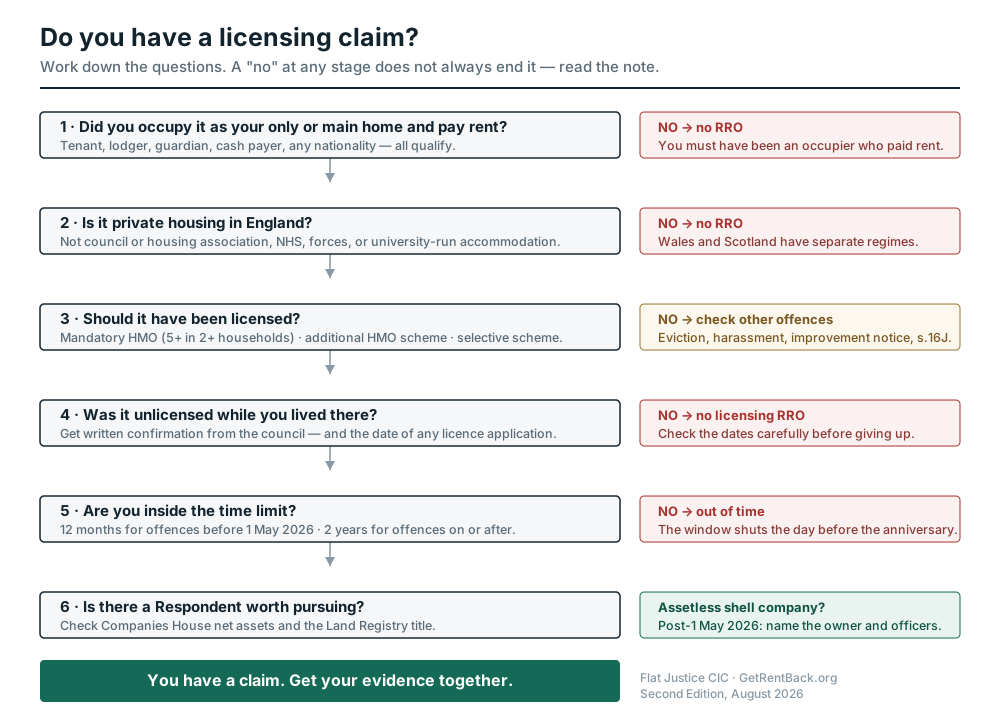
- Anyone who occupied the property as their only or main home and paid rent. Assured tenants, licensees, lodgers, property guardians, and occupiers with only basic protection.
- Anyone, whatever their nationality or immigration status. You can apply from abroad if you have someone in the UK for correspondence. Giving evidence by video from another country is usually possible but needs permission arranged in advance — ask early.
- Tenants who paid in cash. Trickier, but perfectly possible.
- Property guardians in disused offices and industrial buildings. The Court of Appeal has confirmed the right.
- Housemates together. Several tenants of one property can apply in a single application.
Many licence agreements are shams. If there’s no resident landlord you’re most likely a tenant whatever the paper says — that has been the law since Street v Mountford in 1985. And licensees can apply for a Rent Repayment Order in any event.
Who cannot
- Council and housing association tenants, for a licensing claim. Social housing is outside the licensing schemes. An RRO for illegal eviction, harassment or violence to secure entry is a different question and isn’t excluded — if that’s what happened to you, ask us.
- Residents of university and college halls, where the establishment itself manages the building and belongs to one of the approved codes. That exemption depends on who manages the building, not on how it was designed.
- Tenants of NHS bodies, the armed forces, the police and fire authorities — again, for a licensing claim only. One of those bodies somewhere in the ownership chain doesn’t automatically take the building outside licensing: what matters is who actually has control of, or manages, it (Cottam v Lowe Management Ltd [2023] UKUT 306 (LC)).
- Anyone outside England. Scotland and Wales have separate regimes.
- Anyone out of time.
Privately operated purpose-built student accommodation isn’t exempt. The Upper Tribunal has held twice that cluster flats in private student blocks are HMOs, and that the student exemption doesn’t reach private operators because the Secretary of State has never specified them (LDC (Ferry Lane) GP3 Ltd v Garro [2024] UKUT 40 (LC); LDC (Ferry Lane 2) GP3 Ltd v Ayoob [2025] UKUT 205 (LC)). Signing up to a student accommodation code of practice makes no difference to licensing.
Private blocks usually fall outside mandatory HMO licensing, because a building containing three or more self-contained flats is taken out of it. They are still caught by additional and selective licensing where the council has a scheme. Flat Justice has recovered rent for well over a thousand students in these blocks. An ordinary shared student house let by a private landlord is an HMO like any other.
The offences, in plain terms
Letting an unlicensed property
An HMO that needed a licence, or any property in a selective licensing area. Most claims are these, and they are usually the easiest to prove because the council’s own records settle it.
Illegal eviction and harassment
Locking you out, forcing entry, or making your life impossible to drive you out. Harder to prove, because it depends on disputed facts rather than a council record.
Ignoring a council notice
Failing to comply with an improvement notice or a prohibition order. Only the rent paid after the expiry of the deadline can be claimed in an RRO application — which is why you should reach out to the council early.
Abusing the new possession grounds
New from 1 May 2026: evicting you on a ground the landlord knew didn’t apply, or re-letting or marketing the property after using the moving-in or selling ground. More
You may apply on one ground or several — but you get one award, however many offences you prove (Ficcara v James [2021] UKUT 38 (LC)). A second offence strengthens the case; it doesn’t double the money.
Licensing: the three schemes
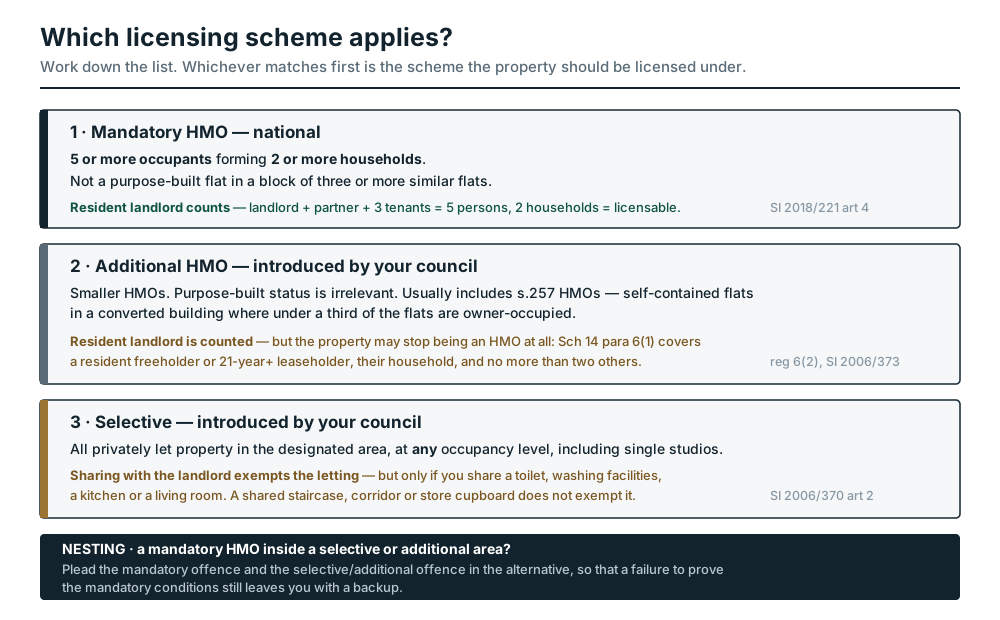
| Scheme | Where it applies | What it catches |
|---|---|---|
| Mandatory HMO | The whole of England | Generally five or more occupants in two or more households sharing an amenity. Not a purpose-built flat in a block of three or more self-contained flats, and not converted blocks of the section 257 kind |
| Additional HMO | Only where the council has declared a scheme | Smaller HMOs — often any house share of three or more |
| Selective | Only where the council has declared a scheme | Any private let in the designated area, including single-family houses and flats — and an HMO too, where Part 2 doesn’t require it to be licensed |
A property only escapes selective licensing if it’s an HMO that Part 2 requires to be licensed — mandatory or additional. So in a borough with a selective scheme but no additional HMO scheme, a house share can be an HMO in fact and still need a selective licence. Liverpool is the obvious example. Landlords argue the opposite; the Upper Tribunal has rejected it (Zaman v Leeds City Council [2026] UKUT 180 (LC)).
Online licence registers are frequently out of date, incomplete, and silent about applications that have been made but not yet determined. They are a starting point, not evidence.
What ends a licensing offence isn’t a register entry and not the grant of the licence — it’s the date a duly made application reached the council. Write to the council and ask three things: whether the property was licensed and for what period; whether an application was made and on what date; and what that council treats as a duly made application. Their written answer is your evidence.
If your landlord lived there too
This is the most misunderstood corner of licensing, and the confusion is usually about the same thing: when does the landlord count as one of the occupants? There is no blanket exemption for a live-in landlord. The short answer is that it depends on how many other people lived there.
A building occupied only by the owner, their household and no more than two other people is not an HMO at all. Once there is a third other person, that exemption falls away — and from then on the landlord and everyone in their household count towards the threshold just like anyone else.
So, scheme by scheme:
- Mandatory: where the property is an HMO, the landlord and their household count towards the five. A live-in landlord, their partner and three tenants is five people in two or more households — and, because there are three others rather than two, the Schedule 14 exemption has gone. Licensable.
- Additional: the same exemption bites much sooner, because these schemes catch smaller houses. A live-in owner with two tenants is outside the HMO definition. Add a third tenant and the property is an HMO — and from that point the owner and their household are counted as occupants alongside the tenants.
- Selective: nothing to do with HMO status or with counting people at all — selective schemes catch every private let in the area, down to a single-occupancy studio. The letting is exempt where you share an amenity with the landlord or their family: a toilet, washing facilities, a kitchen or a living room. Sharing only a staircase, corridor or storage area does not exempt it. A self-contained flat let by a landlord living in another flat in the same house shares no amenity and is not exempt.
Never write a case off because the landlord lived there. Establish who holds the title first.
How much, and how long you have
Offence before 1 May 2026
- Up to twelve months’ rent
- Twelve months to apply
- Immediate landlord only
Offence on or after 1 May 2026
- Up to twenty-four months’ rent
- Two years to apply
- Superior landlords and company officers too
For a licensing offence you can claim a period during which the offence was being committed, up to the maximum. You don’t have to claim the months immediately before you applied — but you cannot include a stretch during which the offence wasn’t actually being committed, for example a spell when an HMO dropped below the licensable number of occupants (Irvine v Metcalfe [2021] UKUT 60 (LC), §27). If the offence is still running when you apply, the claimable period keeps growing right up to the hearing, so update your figures before you go in.
For illegal eviction, harassment, violent entry and misuse of a possession ground, the claimable period is the rent paid in the two years ending with the date of the offence — twelve months, for offences before 1 May 2026. You cannot pick an earlier window.
For a breach of the restriction on re-letting or re-marketing after using the moving-in or selling ground, it’s the two years ending with the date of the offence or, if your tenancy ended before that, the date it ended. That cut-off is easy to miss and it’s the one most likely to apply to a tenant who was evicted and then saw the property back on the market.
You must apply the day before the anniversary of the last whole day of the offence. For a licensing offence the last day is the day before the licence application was duly made. Work it out carefully, then apply well before it.
What it costs
£114 to apply and £227 to be heard — £341 in total. If you’re on a low income or certain benefits you may pay nothing; apply for help with fees at the same time as the application, and note each fee needs its own application. If you win, the tribunal will normally order the landlord to reimburse any fee you paid to you.
One deduction to know about before you start. Any universal credit paid in respect of rent under your tenancy is taken off the amount that can be ordered for that period. If your rent was met in full by the housing element, your own recovery may be nil.
Where it happens
The First-tier Tribunal (Property Chamber). It’s less formal than a court, hearings are normally in person at the tribunal, and you don’t need a solicitor — most applicants don’t have one. Video hearings happen but are the exception, for instance where someone is abroad. Regional practice varies, and your directions are the thing to follow.
What you get, and whether you can collect it
Published awards for licensing offences run from under 10% to the full maximum. Most fall between about 25% and 85% of the rent for the period. The bands, with the cases behind them.
Collecting is a separate question, and it’s why it matters who you name. If the award isn’t paid it can be converted into a county court judgment and enforced, including by a charging order against the property — which is why naming the property owner, where the law now allows it, can be worth more than the size of the award.