Renters’ Rights Act 2025
Straddling offences
Your landlord’s offence started before 1 May 2026 and carried on after it. So which rules apply — the old ones or the new ones? Both. The claim splits at midnight on 30 April 2026, and each half is assessed under its own regime.
The rule, in one paragraph
Regulation 11 of SI 2026/421 disapplies the amendments made by ss.98, 103 and 104 of the Act to Chapter 4 of Part 2 of the Housing and Planning Act 2016. It does two separate jobs. Its first limb switches those amendments off entirely for an offence committed before 1 May 2026. Its second limb deals with a person who commits an offence in rows 3, 4, 5, 6 or 7 of the s.40(3) table for a continuous period starting before 1 May 2026 and ending on or after it, and switches the amendments off only in relation to the period falling before that date.
Both licensing offences are in that list, at rows 5 and 6. So for a licensing offence spanning the date, the months before 1 May 2026 are governed by the old rules and the months from 1 May 2026 by the new ones.
You bring one application covering the whole offence period. You plead the split, and you plead the respondents accordingly: the immediate landlord for the whole period, and the superior landlord and any company officer for the post-1 May portion.
The tenancy-reform offences cannot straddle. The three offences added by the Act sit at rows 2A, 2B and 2C and can only be committed on or after 1 May 2026. Nothing in them runs back across the date, so the split never arises for them.
The saving is limited to amendments made by ss.98, 103 and 104 within that chapter. Section 105, which rewrote the licensing offences themselves in ss.72 and 95 of the Housing Act 2004, is outside it. For the pre-May half of your claim the old offence definitions and the old reasonable-excuse defence apply as a matter of ordinary non-retrospectivity, not because of reg 11.
Worked example
A property in an additional licensing area with no licence. The tenant pays £1,200 a month. The offence runs from 23 March 2026 to 23 June 2026, the licence having been applied for on 24 June 2026.
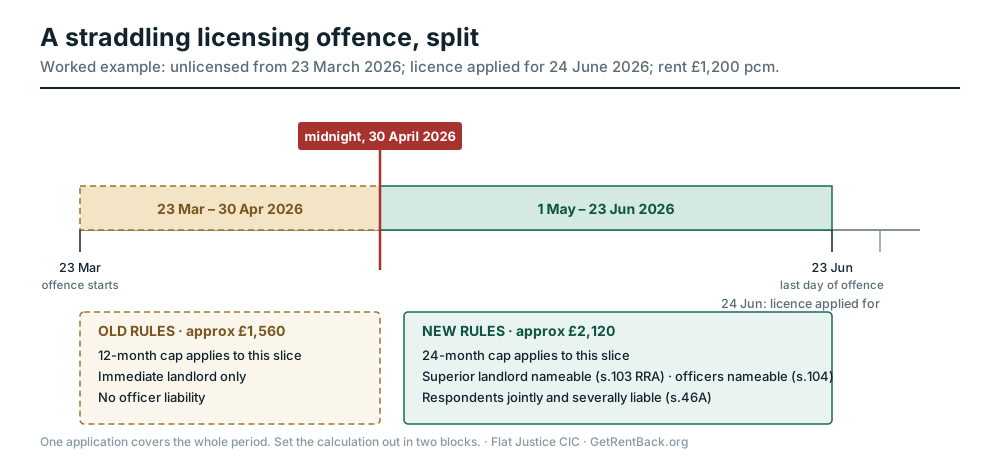
| Period | Regime | Rent | Rules that apply |
|---|---|---|---|
| 23 March – 30 April 2026 (39 days) | Old | £1,560 | 12-month cap; immediate landlord only; no officer liability |
| 1 May – 23 June 2026 (54 days) | New | £2,160 | 24-month cap; superior landlord and officers nameable |
If there’s a rent-to-rent company in the chain with no assets, the post-1 May slice is the part of your claim that can reach the property owner. That may be the whole value of the case.
Why the totals look small at the moment
The post-May block cannot itself reach twenty-four months until 1 May 2028. Take an offence that ran from 1 May 2025 to 30 June 2026:
| Block | Length | Cap | Claimable |
|---|---|---|---|
| 1 May 2025 – 30 April 2026 | 12 months | 12 months | 12 months |
| 1 May 2026 – 30 June 2026 | 2 months | 24 months | 2 months |
Not yet settled: can a straddle exceed twenty-four months in total? If each block carries its own cap, a long offence could in principle total up to thirty-six months. There is a respectable argument the other way. No court has decided it, and the question cannot arise in practice until around 2028. Our position: a short straddle where the pre-May block is twelve months or less is safe arithmetic; anything over twenty-four months in total is an argument to run in the alternative, not a figure to promise anyone. If your claim runs across the changeover, ask us before you fix on a figure.
Who you name, and for which months
The two liability-widening provisions — superior landlords and company officers — are both inside the chapter that reg 11 saves. Neither is available for the pre-May part of a straddling offence. Commencement isn’t the same thing as temporal reach: the provisions are in force, but they don’t reach backwards.
There’s a further wrinkle. Both provisions work by treating a person as having committed the offence, and whether someone can be treated as having committed part of a single continuous offence hasn’t been decided.
Section 105 of the Act rewrote the licensing offences themselves, so that a superior landlord commits the s.72(1) or s.95(1) offence in its own right. That liability could not exist before 1 May 2026 — so the superior landlord’s offence necessarily begins on or after that date and never straddles at all. The straddle belongs to the immediate landlord alone.
Section 105 also sits outside the chapter reg 11 saves, so the saving doesn’t touch it. There are counter-arguments and two real limits on the point, so it’s one to talk through rather than assume.
The deadline trap
The safest reading is that the pre-May portion of a closed straddling offence carries its own twelve-month deadline, expiring 29 April 2027. There are more generous readings, but none of them has been decided. If you’re advising yourself, treat 29 April 2027 as the backstop and apply well before it.
Only matters if the offence has ended. While it’s still running there’s no deadline problem on any reading — you cannot be out of time for an offence that’s still being committed. The date check bites on closed straddles.
Defences also split
The old reasonable-excuse defence survives for conduct before 1 May 2026. Section 105 replaced it going forward with a narrower scheme, and also made a superior landlord liable for the licensing offence in its own right.
In practice the risk here is a research trap rather than a legal question: if you look up s.72 or s.95 of the Housing Act 2004 today you get the version in force from 1 May 2026, which is the wrong text for the pre-May half of your claim. Use the point-in-time version for your offence dates.
Checklist for a straddling claim
- Fix the exact first and last day of the offence. For licensing, the offence ends when a duly made application reaches the council — not when the licence is granted, and not when a register entry appears. Get the council’s written confirmation of that date.
- Count in whole days. Where an element of the offence falls away part-way through a day, that whole day counts as a day the offence wasn’t being committed (Stokki v Choudhury [2026] UKUT 11 (LC), §§17–20). The offence can end a day earlier than you think.
- Split the rent schedule at 30 April / 1 May 2026 and total each block separately, on one month basis.
- Cap the pre-May block at twelve months of rent.
- Cap the post-May block at twenty-four months — in practice, at however many months have elapsed.
- Identify the immediate landlord for the whole period.
- Identify the superior landlord and any company officers, and plead them for the post-May portion.
- If the offence has ended, diarise 29 April 2027 as the safe deadline for the pre-May half.
- Keep updating the figures if the offence is still running — the claimable period grows right up to the hearing.