Renters’ Rights Act 2025
What changed on 1 May 2026
The rent repayment provisions of the Renters’ Rights Act came into force on 1 May 2026. They doubled what you can claim, doubled the time you have to claim it, and opened up who you can claim it from. This page is the plain-English version.
Everything depends on one date
There’s one question to answer before anything else on this site makes sense: when was the offence committed?
The Act’s RRO provisions were brought into force on 1 May 2026 by SI 2026/421. Regulation 11 of those regulations decides which set of rules applies to your claim. In substance it does two things. The main amendments don’t apply at all to an offence committed before 1 May 2026. And where a continuing offence runs from before that date to on or after it, the amendments don’t apply to the part of the period falling before 1 May 2026.
So there’s no cliff edge and no “the tribunal will decide” fudge. A straddling offence is split at midnight on 30 April 2026, and each half is assessed under its own regime.
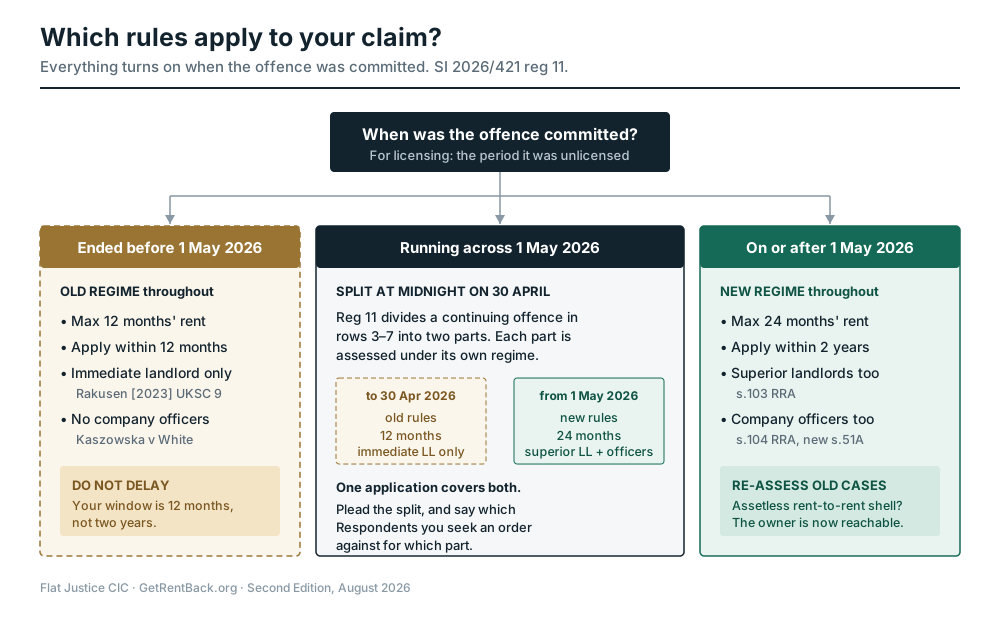
You’re on the old rules throughout, and your deadline is twelve months, not two years. That window may already be closing. Check your date.
The two regimes at a glance
Offence before 1 May 2026
- Twelve months’ rent maximum
- Twelve months to apply
- Your immediate landlord only (Rakusen v Jepsen [2023] UKSC 9)
- Company directors cannot be respondents, because they aren’t landlords (Kaszowska v White [2022] UKUT 11 (LC))
- Seven qualifying offences
- Forced maximum only on conviction or a final penalty, and only for rows 1, 2, 3, 4 and 7 — so never for licensing
Offence on or after 1 May 2026
- Twenty-four months’ rent maximum
- Two years to apply
- Immediate landlord and any superior landlord
- Directors and officers can be named where there was consent, connivance or neglect
- Ten qualifying offences (three more await commencement)
- Multiple respondents are jointly and severally liable
- The licensing carve-out has gone — the forced maximum now reaches every offence in the table
The six changes that matter most
1. Twice as much rent
The maximum went from twelve months’ rent to twenty-four. Note the timing: for the period after 1 May 2026 to reach a full twenty-four months we have to get to 1 May 2028. Until then the arithmetic ceiling on a post-May block is however many months have actually elapsed.
2. Twice as long to apply
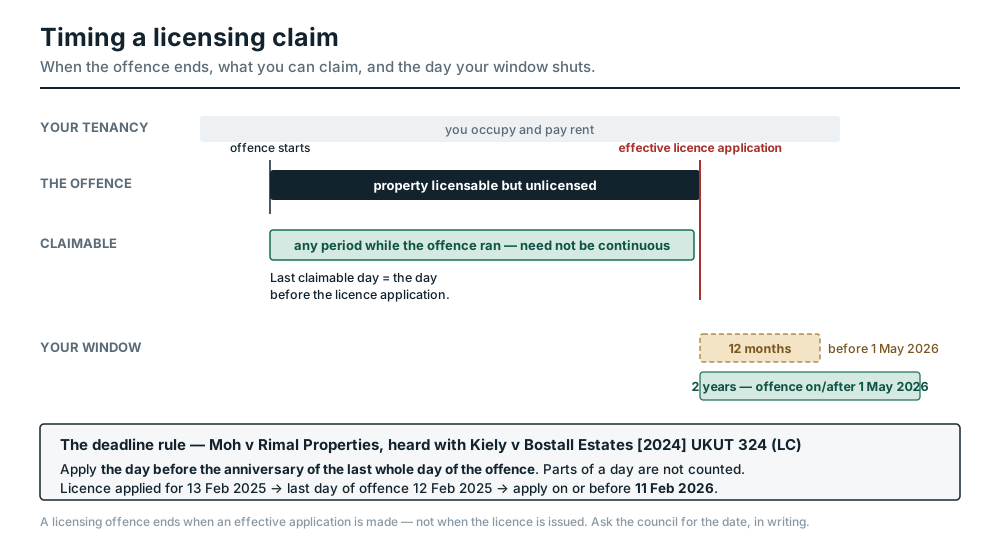
The limitation period went from twelve months to two years. It runs from the offence, and for a continuing offence such as unlicensed letting the clock doesn’t start until the offence stops. The Upper Tribunal has held that the period begins the day after the corresponding date, so you must apply the day before the anniversary of the last whole day of the offence — parts of a day are disregarded (Moh, Facciorusso & Serrano v Rimal Properties Ltd; Kiely, Saunders & Higgins v Bostall Estates Ltd [2024] UKUT 324 (LC), §§36–40).
Where an offence ran across 1 May 2026, it’s not yet decided whether the two-year window carries the whole application or whether the pre-May part keeps its own twelve-month deadline. There’s no authority either way and the official guidance is silent. We work to the cautious answer, and treat the shorter deadline as the one that binds.
3. The rent-to-rent escape route is closed
This is the big one. Before the Act, the Supreme Court in Rakusen held that an RRO could only be made against your immediate landlord. Where that landlord was a rent-to-rent company with no assets, a win was often worthless. For offences on or after 1 May 2026 you can name the superior landlord — typically the property owner — as well. A superior landlord can be ordered to repay rent it never received.
For any period from 1 May 2026, name every potential respondent in a single application: the immediate landlord, the superior landlord, and any director or officer of a company landlord. Never run against the rent-to-rent company first and keep the owner in reserve — a second application is barred from covering the same period under the tenancy.
4. Directors and officers can be personally liable
Where a company commits the offence, an officer of that company is treated as having committed it too, if the offence was committed with their consent or connivance, or is attributable to their neglect. It has to be pleaded and evidenced — it doesn’t follow from the fact that the landlord is a company.
5. Three new offences
Misusing a possession ground, breaching the letting and marketing restrictions after using the moving-in or selling ground, and continuing or repeated breaches of the tenancy reform rules. They were inserted into the middle of the offence table as rows 2A, 2B and 2C, and apply only to offences committed on or after 1 May 2026.
For the first two you do not need to have been the tenant when the offence was committed — which is the point, since the person harmed is usually the tenant who was already evicted.
6. Repeat offenders and convicted landlords face a forced maximum — licensing included
This is the change that has had the least attention and may be worth the most.
Before 1 May 2026, where a tenant applied, the tribunal was only obliged to award the maximum for offences in rows 1, 2, 3, 4 or 7. Rows 5 and 6 — the two licensing offences, which are what most applications are about — were carved out.
That carve-out has gone. The section now sets out two alternative conditions and applies no row restriction at all. So from 1 May 2026:
- a landlord convicted of the licensing offence, or who received a financial penalty for it with no prospect of appeal, attracts the maximum; and
- a landlord with a previous conviction, financial penalty or rent repayment order for the same offence attracts the maximum — at any time, and whether or not it related to the same tenancy or the same property.
The Act also treats the unlicensed HMO offence and the unlicensed house offence as the same offence as each other for that second condition. A landlord with an unlicensed-HMO record therefore triggers the forced maximum on a later selective-licensing offence, and the other way round.
Tribunals have been reluctant to award maximums for licensing offences, partly reasoning that Parliament itself excluded licensing from the mandatory-maximum regime. For offences on or after 1 May 2026 that reasoning has lost its statutory footing. So ask the council whether any civil penalty has been issued against your landlord, for what offence, and whether the appeal period has expired. It’s the single most valuable enquiry you can make.
One thing the change doesn’t do: the tribunal keeps its power to order less where, by reason of exceptional circumstances, it would be unreasonable to require the landlord to pay. That provision survives.
The offence table
An RRO can be made for the offences listed in the table in s.40(3) of the Housing and Planning Act 2016. The three tenancy-reform offences were inserted into the middle of the table as rows 2A, 2B and 2C — not added on the end.
The row number decides which period your claim is measured over. Several published summaries number the new offences 8, 9 and 10. That’s wrong: rows 8, 9 and 10 are reserved for the landlord redress scheme and database offences, which are not in force. If a source numbers them 8 to 10, check everything else it says as well.
| Row | Offence | Provision | Available for |
|---|---|---|---|
| 1 | Violence for securing entry | s.6(1) Criminal Law Act 1977 | All dates |
| 2 | Eviction or harassment of occupiers | s.1(2), (3) or (3A) Protection from Eviction Act 1977 | All dates |
| 2A | Knowingly or recklessly misusing a possession ground | s.16J(1) Housing Act 1988 | From 1 May 2026 |
| 2B | Breach of the restriction on letting or marketing a dwelling-house | s.16J(2) Housing Act 1988 | From 1 May 2026 |
| 2C | Tenancy reform: continuing breaches | s.16J(3) Housing Act 1988 | From 1 May 2026 |
| 3 | Failure to comply with an improvement notice | s.30(1) Housing Act 2004 | All dates |
| 4 | Failure to comply with a prohibition order | s.32(1) Housing Act 2004 | All dates |
| 5 | Offences relating to unlicensed HMOs | s.72(1) Housing Act 2004 | All dates |
| 6 | Offences relating to unlicensed houses | s.95(1) Housing Act 2004 | All dates |
| 7 | Breach of a banning order | s.21 Housing and Planning Act 2016 | All dates |
| 8–10 | Reserved for the landlord redress scheme and private rented sector database offences | Not in force | |
Which period your claim is measured over
The row your offence sits in decides the answer, and the three possibilities are quite different. This is the most practical reason to get the numbering right.
| Rows | The amount relates to rent paid in respect of |
|---|---|
| 1, 2, 2A | the period of two years ending with the date of the offence |
| 2B | the period of two years ending with the date of the offence — or, if the tenancy ends before that date, the date it ends |
| 2C, 3, 4, 5, 6, 7 | a period, not exceeding two years, during which the landlord was committing the offence |
The row 2B cut-off is the one that catches people out. If your landlord evicted you on the moving-in or selling ground and then re-let or re-marketed the property, your window is measured back from the date your tenancy ended, not from the date they broke the rule.
Whatever the maximum, the amount the tribunal can order for any period is the rent paid by or on behalf of you, less any relevant award of universal credit paid to anyone in respect of rent under the tenancy for that period. If your rent was met in full by the housing element, your own recovery may be nil. Work this out before you do anything else.
What isn’t in force yet
Rows 8, 9 and 10 of the table — the landlord redress scheme and private rented sector database offences — were inserted by the Act but their commencement was deferred. A further commencement order is needed before they bite. Until then only rows 1 to 7, including 2A to 2C, are operative.
You’ll see the amended sections cross-refer to rows 8, 9 and 10 even though the table itself stops at 7. That’s why. It isn’t a drafting error, and those rows are not the tenancy-reform offences.
Sources
- Renters’ Rights Act 2025 — ss.62, 98, 103, 104 and 105
- Housing and Planning Act 2016, Part 2 Chapter 4 (ss.40–52) as amended
- The Renters’ Rights Act 2025 (Commencement No. 2 and Transitional and Saving Provisions) Regulations 2026, SI 2026/421 — especially regs 3 and 11
- MHCLG, Rent Repayment Orders: guidance for tenants
- Rakusen v Jepsen [2023] UKSC 9, on the position before 1 May 2026
Sources note: reg 11 applies to the amendments made by ss.98, 103 and 104 to Chapter 4 of Part 2 of the Housing and Planning Act 2016. Section 105 sits outside that chapter — it rewrites the licensing offences themselves in ss.72 and 95 of the Housing Act 2004.
The Act rewrote the licensing offences. If you read s.72 or s.95 of the Housing Act 2004 today you’re reading the version that applies from 1 May 2026 — the wrong version for an earlier offence period. Use the point-in-time link for the dates of your offence.